
Deep work signals for distributed teams
Turn activity patterns into actionable focus insights for managers — without micromanaging every app switch.
 Hubnity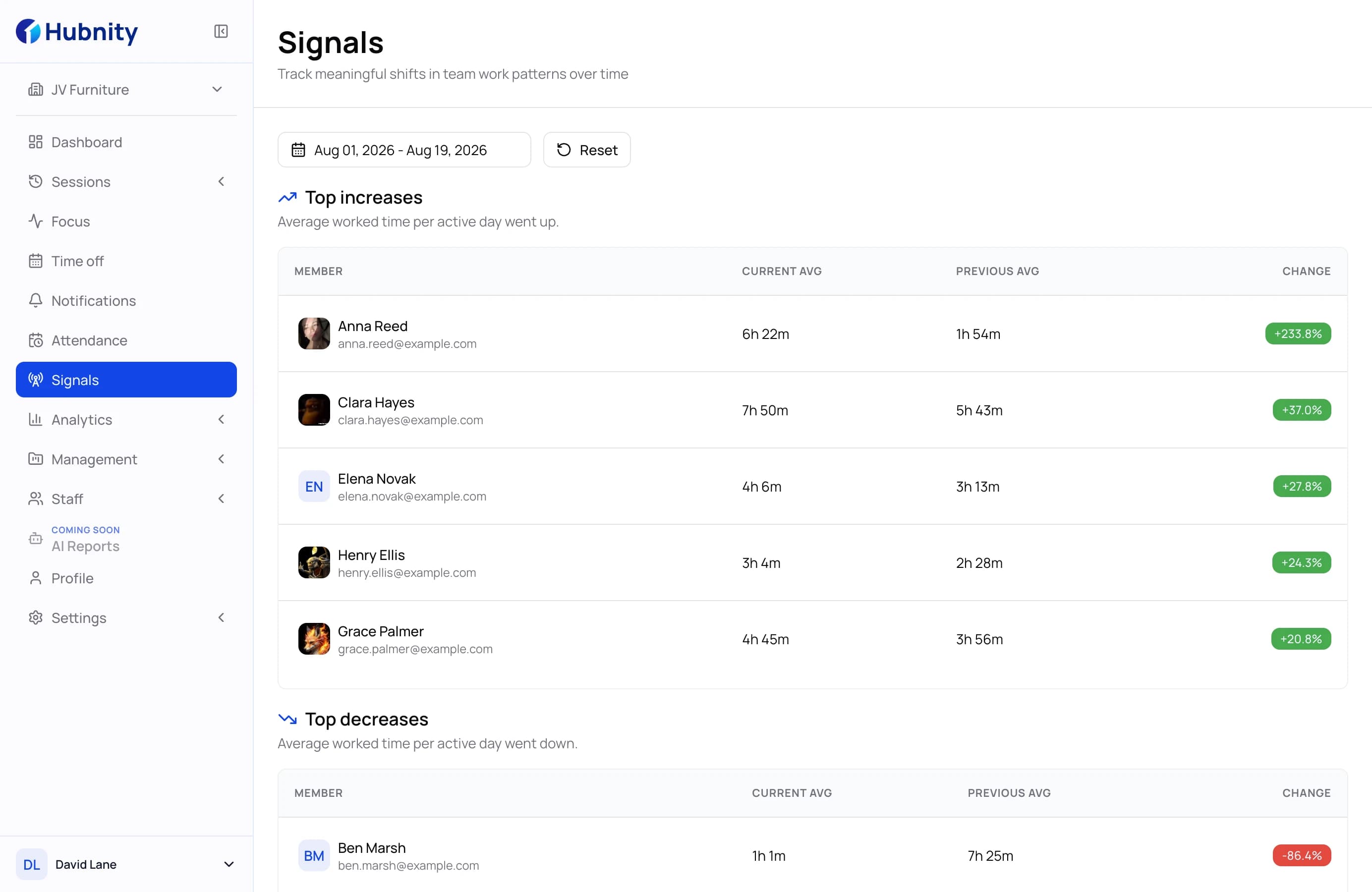
Distributed teams need visibility into focus patterns without turning managers into screen watchers. The goal is to spot trends that affect delivery — not to score every minute or punish a slow Tuesday afternoon.
Look for patterns, not single anomalies
A one-day dip in focus time is normal. A three-week trend across a project team is a signal worth discussing in a planning session.
Context matters: release weeks, onboarding periods, and cross-team dependencies all change activity shapes temporarily.
- Review team-level trends weekly, not individual snapshots daily
- Compare focus blocks against sprint commitments
- Pair activity data with qualitative check-ins
Separate collaboration load from distraction
High messaging volume is not always a productivity problem. Sometimes it reflects coordination-heavy project phases.
Look at the ratio between focused work blocks and reactive work. That ratio often explains delivery risk earlier than total hours.
Protect focus time intentionally
Deep work requires calendar protection. Teams that protect two focus blocks per day consistently outperform teams that rely on heroic evening work.
Use activity trends to justify fewer meetings — not to add more reporting.
"Visibility should create space for focus, not justify more interruptions."
Turn signals into team agreements
When data surfaces a pattern, convert it into a team norm: quieter mornings, fewer status meetings, or clearer handoff windows.
Shared agreements work better than manager mandates in distributed environments.
Practical steps to apply this week
- Identify one recurring meeting that overlaps with focus blocks
- Review team focus trends for the last three weeks
- Agree on two protected focus windows per role
- Revisit patterns in your next retrospective
Conclusion
Deep work signals are useful when they inform workflow design. They fail when used as surveillance shortcuts.
Distributed teams that treat focus as a shared resource ship more predictably — with less burnout.

Hubnity
Practical guidance from the Hubnity product and operations team.
Related articles
 Employee Productivity
URL tracking policies that balance privacy and insight
Define what domains are in scope, how data is retained, and how employees can audit their own activity history.
7 min readHubnity Employee Productivity
Reducing meeting load with async status updates
Replace low-value syncs with structured written updates tied to tracked work blocks and delivery milestones.
5 min readHubnity Remote Teams
How to build a time tracking policy remote teams actually trust
A practical playbook for rolling out time tracking without hurting morale — from policy wording to privacy defaults.
8 min readHubnity